


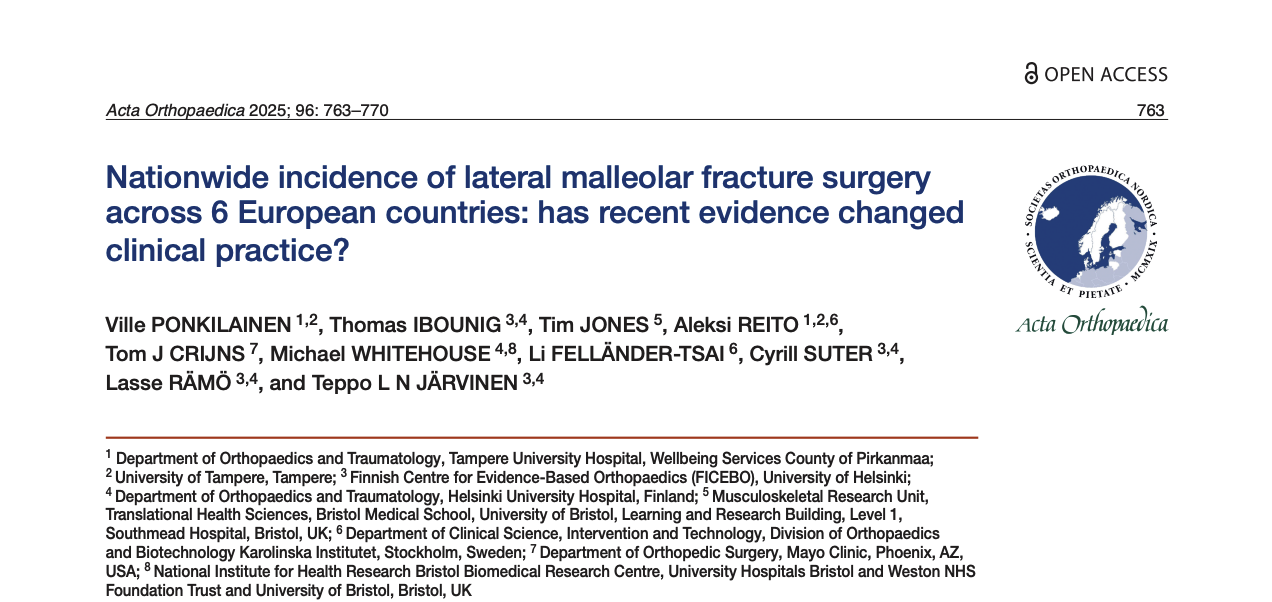
A new study led by FICEBO researchers and published in Acta Orthopaedica reveals striking variation in the surgical treatment of isolated lateral malleolar fractures across six European countries.
The study was initiated to explore real-world practice patterns and to support the relevance of another ongoing large-scale FICEBO project on ankle fractures. Beyond its immediate findings, the work reflects one of FICEBO’s core research themes — sustainability in healthcare — where practice variation serves as a key indicator of low-value care.
The collaboration was truly international, bringing together data and researchers from Finland, Sweden, Switzerland, Austria, and the United Kingdom. The project began as a conversation at the AAOS meeting in San Francisco in 2024, and through persistence and teamwork — particularly by Thomas Ibounig and Ville Ponkilainen — evolved into a successful multinational analysis.

Key findings
- The rate of surgical fixation for isolated lateral malleolar fractures varied more than sixfold between countries.
- Surgery was most frequent in Germany and Austria, while England had the lowest surgical rate.
- During the past decade, surgical treatment rates have decreased by 20–30% in Finland, Sweden, Switzerland, andEngland — but not in Germany or Austria.
- The findings underscore the substantial variation in clinical practice, reflecting how slowly (and unevenly) evidence-based approaches are adopted across Europe.
FICEBO asks — Tom and Ville answer
FICEBO’s researcher bios always include a few personal questions, so we thought to ask our newest collaborators, too.
Q1:This was your first project with FICEBO — how did the collaboration start, and what was it like to work on?
Tom: Our collaboration started when Imet Dr. Teppo Järvinen and Ville through a mutual friend at AAOS in San Francisco last year. I was of course familiar with some of the groundbreaking work that the FICEBO group has been doing with regards to randomized trials in Orthopedic surgery and was very excited to participate in this project. I am originally from Amsterdam, The Netherlands and I am currently working as a resident in the USA, where the culture with regards to healthcare is vastly different. I think diversity of opinion is critically important in medicine and science in general, so it was great to be able to be a part of a group with such a unique perspective and research interest.
Ville: As usual, the best academic discussions happen during conference trips, where you meet like-minded people who share similar interests. This project actually began during my first-ever face-to-face conversation with Teppo and Thomas. I had previously worked with similar data and was honoured to be invited to collaborate with FICEBO. I always enjoy working with new people from different backgrounds and with diverse skills — there’s always something valuable to learn from them.
Q2:What surprised you most in the results?
Tom: I believe that where there is variation in care, there is room for improvement. Our current study demonstrated that there is notable variability in care on an international level which is important and underlines the need for further rigorous, high-level research on ankle fracture care.
Ville: The magnitude of the regional variation was, of course, surprising. I was particularly struck by how high the rates in Finland were—almost three times those in England. I had thought we were quite conservative in Finland, as we are with many low-value elective procedures, but clearly there’s still room for improvement.
Q3:Why do you think practice variation in orthopaedic trauma care persists, even when evidence accumulates?
Tom: Clinical adaptation of the current best evidence is a continued problem in Orthopedics and is likely a combination of variability in the interpretation of evidence (diversity of opinion), culture (as surgeons we are trained to operate and this is an important part of our professional identity), and financial incentives. Some of the challenges we face is training the next generation of surgeons in critical thinking and thorough evaluation of scientific evidence. We need more people like the researchers in the FICEBO group who are interested in challenging the dogma in our field.
Ville: This is indeed a highly relevant and timely question that we’ve been exploring in recent years. Last year, we published an article (DOI:10.2340/1745-3674.2024.41930) on regional variation in low-value musculoskeletal surgery in Finland, where we discussed several contributing factors—such as historically higher surgical rates and the tendency for higher rates in smaller non-university hospitals. Based on the reactions our findings received at national congresses, surgical indications seem to be a personal and sometimes sensitive topic for many surgeons. These factors seem hard to change.
Q4:And finally — a FICEBO classic: who or what inspires you as a researcher?
Tom: I thoroughly enjoy being involved in research because it exposes me to new ideas and hones my critical thinking skills. It also allows me to be engaged in patient care on a larger, possibly even global scale, and will make me a better surgeon and physician in the process.
Ville: I’m mostly inspired by continuous learning and improvement as a researcher. My goal is to make each project better than the previous one and to learn from every challenge I face along the way. This project was once again a great opportunity to learn from more experienced researchers and to become a little better at what I do.


Stay up to date
Follow FICEBO on social media to stay in the loop with our latest updates.
